
The rationalisation of goods and services tax (GST), announced on Wednesday, directly lowers the cost of everyday medical consumables, and also high-end therapies in oncology and rare diseases, helping reduce out-of-pocket patient expenditure and better adherence to medication.
Reduction of GST on health insurance premium from 18% to 0% looks like a straight 18% reduction in what consumers pay. The truth, however, is...

Recent years have been turbulent for the insurance industry due to direct and indirect tax reforms, regulatory overhaul and other external pressures. The events cumulatively slowed growth rate to single digits from the high teens seen earlier.

About 1.2 trillion tax evasion cases have been detected and as many as 59,000 entities identified for verification in order to ascertain whether they are fake.
GST authorities have identified about 17,000 non-existent GSTINs and cancelled over 4,900 registrations in the ongoing pan-India drive against fake registration, a senior tax official said on Wednesday. Currently, there are 1.40 crore businesses registered under Goods and Services Tax, nearly double the number of businesses registered in indirect tax regime pre-GST rollout. Central Board of Indirect Taxes and Customs (CBIC) member Shashank Priya said in the drive against fake registration, till July 4, over 69,600 GST Identification Numbers (GSTINs) have been selected for physical verification by field tax officers.
In a relief for foreign firms giving loans to Indian subsidiaries, tax authorities have said goods and services tax (GST) will not be imposed on them, subject to some caveats. Additional fees, commissions, or related payments - over and above the amount charged as interest - on these loans will attract GST at 18 per cent, the Central Board of Indirect Taxes and Customs (CBIC) has said.

These losses increase insurance premiums for customers and reduce insurer margins on the other.
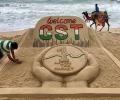
Six years after the rollout of the biggest indirect tax reform in India, Goods and Services Tax (GST) revenue of Rs 1.5 lakh crore every month has become a new normal and tax officers are focusing on dealing with fraudsters who are adopting newer modus operandi to game the system, causing loss to the exchequer. To apprehend black sheep, who operate as syndicates and create fake entities on the basis of forged documents to claim input tax credit (ITC), tax officers have started using data analytics, artifical intelligence and machine learning aiming to curb evasion, which was over Rs 3 lakh crore since inception of GST. It was over Rs 1 lakh crore in 2022-23. Thinktank Global Trade Research Initiative (GTRI) said the most critical pending GST reform is upgradation of GST Network to prevent fake supplies and fraudulent claims of Input Tax Credit (ITC).

The new restriction will be challenging for businesses, as they will have to do regular follow-ups with their suppliers.

The exemption of individual life and health insurance premiums from the Goods and Services Tax (GST) enables the insurance industry to make products affordable and attractive, said Ajay Seth, chairman of Insurance Regulatory and Development Authority of India (Irdai) at the Business Standard BFSI Insight Summit 2025.
The GST Council in its meeting next week is likely to consider a proposal for making changes in the monthly tax payment form -- GSTR-3B, which would include auto-population of outward supplies from sales return and non-editable tax payment table, officials said. The move would help curb the menace of fake billing, whereby sellers would show higher sales in GSTR-1 to enable purchasers to claim input tax credit (ITC), but report suppressed sales in GSTR-3B to lower GST liability. Currently, GSTR-3B of a taxpayer includes auto drafted input tax credit (ITC) statements based on inward and outward B2B supplies and also red flags any mismatch between GSTR-1 and 3B.
Businesses with monthly turnover of over Rs 50 lakh will have to mandatorily pay at least 1 per cent of their GST liability in cash, the finance ministry said as it moved to curb evasion by fake invoicing. The Central Board of Indirect Taxes and Customs (CBIC) has introduced Rule 86B in Goods and Services Tax (GST) rules which restricts use of input tax credit (ITC) for discharging GST liability to 99 per cent. "... The registered person shall not use the amount available in electronic credit ledger to discharge his liability towards output tax in excess of 99 per cent of tax liability, in cases where the value of taxable supply ... in a month exceeds Rs 50 lakh," the CBIC said.

Some of the key names include: Maruti, M&M, Ashok Leyland, Britannia, Ultratech, JK Cement, Havells, Voltas, Amber, Metro, Trent, LemonTree, Indian Hotels, Niva Bupa, HDFC Life, IGL, Acme Solar, Suzlon, Swiggy, Delhivery, ICICI Bank, HDFC Bank, Bajaj Finance, Shriram Finance," according to a report by Motilal Oswal Financial Services.

Average monthly GST collection rose from Rs 90,000 crore during the first year of its implementation -- 2017-2018 -- to Rs 1.68 trillion during 2023-2024, representing an 87 per cent rise.

The GST Council had given the option to real estate companies to either opt for old rates of 12% (for residential) and 8 per cent (affordable housing) with ITC benefits or the new tax rates of 5% for residential units and 1% for affordable housing without the benefit of adjusting the credit on inputs used during construction.

InterGlobe Aviation, the operator of IndiGo, has approached the Delhi high court seeking a refund of over Rs 900 crore it claims to have paid as Customs duty on aircraft engines and parts re-imported into India after overseas repairs. The petition came up for hearing on Friday before a bench of Justices Prathiba M Singh and Shail Jain.

GST officers can now launch prosecution against offenders in cases where the amount of evasion or misuse of input tax credit is more than Rs 5 crore, the finance ministry has said. However, this monetary threshold will not be applicable in the case of habitual evaders or in cases where arrests have been made at the time of investigation. "One of the important considerations for deciding whether prosecution should be launched is the availability of adequate evidence," the GST investigation wing under the finance ministry said, while issuing instructions for launching prosecution.

The reduction in goods & services tax (GST) on individual life and health insurance premiums has been called a "landmark step" for making insurance affordable and inclusive. In a panel discussion at the Business Standard BFSI Insight Summit 2025, Anup Bagchi, managing director (MD) & chief executive officer (CEO) of ICICI Prudential Life Insurance; Mahesh Balasubramanian, MD & CEO of Kotak Life Insurance; Tarun Chugh, MD & CEO of Bajaj Life Insurance; and Ratnakar Patnaik, MD of Life Insurance Corporation of India (LIC), listed what else the industry needs to reach more people.

Simplifying GST rates, removing exemptions, easing disputes, and speeding up refunds can boost investment in India and offer the best reply to Trump's tariffs, observes V S Krishnan, former member, Central Board of Indirect Taxes and Customs.
The GST intelligence unit detected tax evasion of more than Rs 1.98 lakh crore last year and arrested 140 masterminds who were involved in defrauding the exchequer, the finance ministry said on Thursday. In 2023, the Directorate General of GST Intelligence (DGGI) detected significant GST evasion in diverse sectors like online gaming, casinos, insurance and secondment (import of manpower services). "DGGI has achieved an increase in detection of cases of evasion and voluntary payments. In 2023, DGGI detected 6,323 cases involving evasion of duty of Rs 1,98,324 crore with a voluntary payment of Rs 28,362 crore.

GST rates on under-construction houses maybe reduced from 12 pc with input tax credit to 5 pc without ITC. Similarly, the rate for under-construction affordable houses could come down to 3 per cent without input tax credit, from the current 8 per cent.

'That is going to have an impact on literally every one, whether you buy a toothpaste, a safety pin, a car, shoes or medicines or you go to a diagnostic centre.'
With Goods and Services Tax (GST) officers under pressure to exceed the Rs 1-trillion collection mark per month, industry has faced a barrage of recovery notices and summons issued over the last one month across sectors, according to company executives. Industry bodies have claimed harassment by field officers, blocking of input tax credit, cancellation of GST registration, threats of arrest and steep penalties, impacting their working capital and operations. Company executives pointed at an atmosphere of apprehension and fear due to such notices and summons.

The move will help address apprehensions as well as potential disputes on various computational and transitional issues such as the loss of input credits and pricing that were bound to arise on account of the change.

Telecom services providers have urged the Ministry of Finance to suspend the universal service obligation (USOF) till the existing corpus is exhausted. In their Budget recommendations, they have also pressed for an exemption from the service tax on "assignment of right to use natural resources" and the slashing of Customs duty on telecom equipment to zero. The Cellular Operators Association of India (Coai), which represents private sector telecom operators Reliance Jio, Bharti Airtel, and Vodafone Idea, called for abolishment of USOF levy.

Govt doesn't buy restaurants' input tax excuse and has swing into action and looking into profiteering complaints on social media against prominent restaurant and franchise chains.
Lower rates effectively increase disposable income, strengthen purchasing capacity, and support broader consumption growth.

The highest-ever goods and services tax (GST) evasion has been done by the online money gaming industry.

Ask rediffGURU and PF expert Nitin Narkhede your mutual fund and personal finance-related questions.

Adding petrol and diesel to GST was a challenging task due to their significant role as revenue generators for both the central and state governments.
GST authorities have detected GST fraud of Rs 55,575 crore over the last two years and arrested over 700 persons for causing loss to the exchequer, an official said on Thursday. Over 22,300 fake GST identification numbers (GSTIN) were detected by the officers of the Directorate General of GST Intelligence (DGGI). The government on November 9, 2020, launched a nationwide special drive against unscrupulous entities for availing and passing on Input Tax Credit (ITC) fraudulently by issuing fake/bogus invoices, thereby evading Goods and Services Tax (GST).
Experts said the rate hike would improve working capital position of the manufactures as it would correct the inverted duty structure but may lead to increase in price of the finished goods.

Experts said this will mean that companies, which have offices in multiple states, will have to raise Goods and Services Tax invoice for functions performed by employees in head office that has helped branches in other states.
As taxpayers face technical glitch on the GST portal, the government on Tuesday said it is considering extending the April tax payment deadline and has directed Infosys for early resolution of the problem. The Central Board of Indirect Taxes and Customs (CBIC) said a technical glitch has been reported by Infosys in generation of April 2022 GSTR-2B and auto-population of GSTR-3B on portal. "Infosys has been directed by Govt for early resolution. Technical team is working to provide GSTR-2B & correct auto-populated GSTR-3B at the earliest," the CBIC tweeted.

Reliance General Insurance Company (RGIC), a subsidiary of Reliance Capital, finds itself in a bind as the Directorate General of GST Intelligence (DGGI) has issued multiple Show Cause Notices (SCNs) amounting to Rs 922.6 crore. This development comes at a time when Reliance Capital is currently undergoing a debt resolution under the National Company Law Tribunal (NCLT) process in which the Hinduja group has emerged the winner. The Hinduja acquisition is currently awaiting the Supreme Court's approval after the Torrent group, the winner of the first round, challenged the second auction conducted by the lenders of Reliance Capital.

The government has notified a host of procedural changes in the GST rules, including levy of interest for wrongful utilisation of ITC and turnover threshold for filing annual returns for the 2021-22 fiscal. The changes were vetted by the Goods and Services Tax (GST) Council at its meeting last week. With the amendments notified by the Central Board of Indirect Taxes and Customs (CBIC), businesses have also been allowed to make tax payments on the GSTN portal by using IMPS and UPI payment modes.
The finance ministry has set up two committees of state finance ministers which would rework rate slabs, review GST exempt items and identify potential evasion sources. Four years after the roll out of the national Goods and Services Tax (GST), which replaced the complex indirect tax structure, the centre and states have started work on moving towards a "simpler rate structure in GST" by reviewing the current rate slabs, including special rates and merger of rate slabs. The Group of Ministers (GoM) on rate rationalisation would also review items under inverted duty structure to help minimise refund payout, and review the supply of goods and services exempt under GST with an objective to expand the tax base and eliminate breaking of input tax credit (ITC) chain.

Tata Starbucks had hiked the base price of one its coffee variant after the GST Council cut tax rates on restaurants from 18 per cent to 5 per cent with effect from November 15, 2017.

Central Board of Excise and Customs Chairperson Vanaja Sarna said there will be genuine errors due to lack of understanding in the initial days. "CBEC has enforcement authorities and I have specifically said that the first three to six months are a go-slow.... I don't want small cases to be made," Sarna said at a CII event.

The government should bring natural gas under the Goods and Services Tax (GST) regime to realise Prime Minister Narendra Modi's vision for a gas-based economy and raising the share of the environment-friendly fuel in India's energy basket, an industry body that represents the likes of Reliance Industries as well as state-owned firms, has said. Natural gas is currently outside the ambit of GST, and existing legacy taxes -- central excise duty, state VAT, central sales tax -- continue to be applicable on the fuel. In its pre-Budget memorandum to the finance ministry, Federation of Indian Petroleum Industry (FIPI), which boasts of members from across the oil and gas spectrum, also demanded rationalisation of GST on transportation of natural gas through pipeline as well as on re-gasification of imported LNG to help bring down cost of the environment friendly fuel.
